
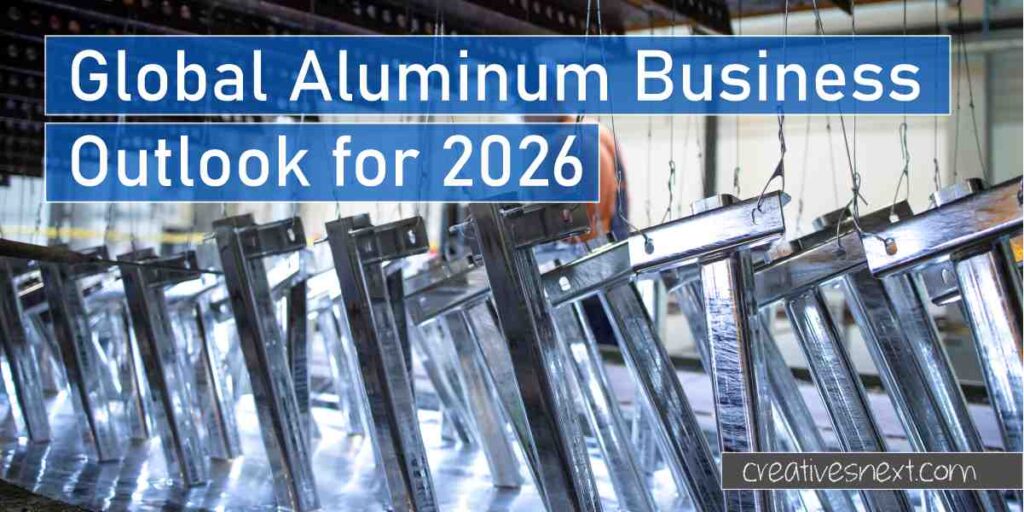
Global Aluminum Business Outlook for 2026
Published on 11 November 2026
Table of Contents
Introduction
Due to its low weight, high strength, corrosion resistance, and conductivity, aluminum finds extensive use in the manufacturing sector.
Its main uses are in electronics (heat sinks, casings), construction (windows, doors, cladding), packaging (cans, foil), and transportation (automotive, aerospace, marine).
Its alloys are used to make a wide variety of goods, from specialist parts for ships and airplanes to domestic appliances and utensils and can be designed to be stronger than steel.
Aluminum’s primary applications in manufacturing
- Transportation: Its low density makes it suitable for decreasing fuel usage in cars, trucks, aircraft, and trains.
- Construction: Because of its formability and resistance to corrosion, it is used in building frames, doors, windows, and cladding.
- Packaging: Because it shields contents from light, oxygen, and moisture, packaging is a common option for beverage cans, foil, and caps.
- Electronics: Used for conductive components and heat sinks and device casings that effectively dissipate heat.
- Appliances and household goods: Found in household appliances like refrigerators and dishwashers, and also used for cookware such as saucepans.
- Marine: Because it is lightweight and resistant to corrosion, it is used in the construction of ships and offshore buildings.

The Global Aluminum Business Outlook
Navigating the Green Transition and Geopolitical Currents
As we look toward 2026, the global aluminum industry stands at a critical juncture. Long known as the “green metal” for its infinite recyclability, it is now grappling with the immense challenge of cleaning up its primary production process.
The outlook for 2026 is not a simple story of supply and demand, but a complex narrative shaped by the forces of decarbonization, geopolitical realignment, and the relentless pulse of emerging markets.
The industry is set for a period of constrained growth, strategic consolidation, and a definitive split between “green” and “brown” aluminum. Here’s what to expect.
1. The Decarbonization Imperative: A Market Divided & Eagerly Watching for Aluminum Business Outlook
The most powerful trend reshaping the aluminum sector is the push for a lower carbon footprint. By 2026, this will no longer be a niche concern but a core market driver.
- The Premium for “Green Aluminum” for the Manufacturing Companies: Aluminum produced using renewable energy (hydro, solar, wind) will command a significant and growing price premium. Markets like the European Union, with its Carbon Border Adjustment Mechanism (CBAM), will effectively penalize high-carbon imports, making sustainably produced metal more competitive. This will benefit producers in regions with rich hydropower resources, such as Canada, Norway, and Russia (despite geopolitical tensions), and those investing heavily in new green smelting technologies.
- The “Brown Aluminum” Squeeze: Conversely, smelters reliant on coal-fired power, predominantly in China and India, will face rising operational and compliance costs for the manufacturing companies. While they will continue to dominate volume production, their access to premium Western markets will become more difficult and expensive. The industry will see a de facto bifurcation, with two parallel markets operating under different cost structures and price points.
2. Supply Dynamics & Stability Over Surge for the Global Aluminum Business Outlook
The supply side in 2026 is expected to be tight rather than surplus.
- China’s Evolving Role: China, the world’s aluminum powerhouse and extremely crucial for the Global Aluminum Business Outlook, is reaching its domestic capacity cap. Its focus is shifting from explosive growth to internal consolidation, efficiency gains, and slowly transitioning its energy mix. While it will remain the dominant producer, its export growth is likely to plateau, providing a floor for global prices.
- Geopolitical and Energy Volatility: The war in Ukraine has demonstrated the fragility of European aluminum production, which has been shuttered due to soaring energy costs. Even by 2026, a full recovery is uncertain, keeping a significant portion of supply offline. Furthermore, political instability in Guinea, a key source of bauxite, continues to pose a risk to the raw material supply chain.
- Recycling’s Rising Star: Secondary aluminum production (from recycling) will be the fastest-growing segment. Its energy requirement is a mere 5% of primary production, making it a clear winner in the decarbonization race. By 2026, advanced sorting and recycling technologies will make high-quality recycled aluminum a mainstream feedstock for the automotive and packaging industries.
3. Demand Drivers for the Aluminum Companies : The Pillars of Future Growth & the Aluminum Business Outlook
Demand for the global aluminum business is projected to grow at a steady 2-3% annually through 2026, fueled by its essential role in modern, green technologies.
- The Electric Vehicle (EV) Revolution: This is the single biggest demand driver. Aluminum’s lightweight properties are crucial for extending the range of EVs. From body structures and battery enclosures to powertrain components, every new EV represents a significant amount of aluminum. As EV adoption accelerates globally, so too will demand.
- Sustainable Packaging: The push to eliminate single-use plastics continues to benefit aluminum. Its superior recyclability makes cans and foil the packaging material of choice for environmentally conscious brands and consumers.
- Construction and Infrastructure: While the traditional construction sector may see cyclical fluctuations, aluminum’s use in green building design (for energy-efficient windows and facades) and in large-scale renewable energy projects (solar panel frames, wind turbine components) will provide stable demand.
4. Aluminum Business Outlook amid Geopolitics and Trade: The New Rules of the Game
The era of frictionless global trade is over. By 2026, the aluminum market will be deeply influenced by geopolitical strategies.
- Regional Blocs and Friend-Shoring: The U.S. Inflation Reduction Act (IRA) and the EU’s Green Deal are incentivizing the creation of regional, politically aligned supply chains. We will see more investment in North American and European production to serve local demand, reducing reliance on long-distance, geopolitically risky imports.
- China’s Belt and Road and Strategic Stockpiling: China will continue to secure its raw material flows through its Belt and Road Initiative, particularly in Africa and Southeast Asia. Additionally, nations may increasingly view aluminum as a strategic material, leading to government stockpiling that can artificially tighten markets.

Conclusion: The Strategic Landscape & Aluminum Business Outlook in 2026
The global aluminum business in 2026 will be characterized by:
- A Two-Tier Market: A clear price and market-access divide between low-carbon and high-carbon aluminum.
- Constrained but Stable Growth: Supply will be tight, supporting higher average price floors than in the previous decade, but without the extreme volatility of the early 2020s.
- Technology as a Differentiator: Investment in inert anode technology, carbon capture, and advanced recycling will become key competitive advantages.
- Resilience over Efficiency: The focus for major consumers (like automakers) will shift from just-in-time supply chains to secure, traceable, and politically acceptable sources of supply.
For industry leaders, the path forward is clear: adapt or be left behind.
The winners in the 2026 aluminum market will be those who successfully navigate the green transition, build resilient and transparent supply chains, and align their strategies with the inexorable global demand for a cleaner, more sustainable future.
For more Industry Outlook, click here. This is a human crafted content, assisted by AI.