
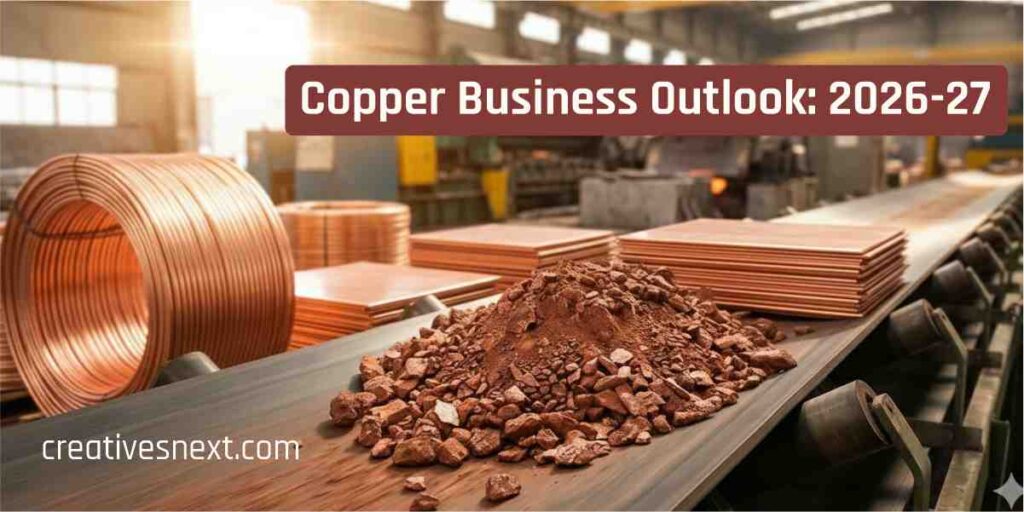
The Copper Conduit: A Comprehensive Copper Business Outlook for 2026-2027
Published on 21 January 2026
Disclaimer: Some links in this site are affiliate links. As an Amazon Associate, we earn from qualifying purchases.
Table of Contents
Introduction: The Red Metal at a Crossroads
2025 is over and well into 2026. Let’s talk on the red metal.
Copper stands poised at one of the most consequential junctures in its millennia-long history as civilization’s essential metal.
The 2026-2027 period represents not merely another two-year business cycle, but a decisive inflection point where energy transition ambitions collide with supply realities, technological innovation meets geological constraint, and geopolitical maneuvering reshapes global trade flows.
This exhaustive analysis will dissect the multifaceted outlook for copper, spanning supply dynamics, demand catalysts, price trajectories, technological disruptions, sustainability imperatives, and strategic implications for stakeholders across the value chain.

1. The Macro Backdrop: Global Economic Context for 2026-2027
Growth and Inflation Dynamics in the Copper Business Outlook
The 2026-2027 period is expected to unfold against a backdrop of moderated global growth (2.8-3.2% annually) with persistent regional divergences.
Advanced economies will likely navigate the lingering effects of monetary tightening, while emerging markets—particularly in Asia—drive incremental growth. Inflation is projected to stabilize near central bank targets, but structural factors (demographic shifts, deglobalization, climate policies) maintain underlying pressure.
Energy Transition Acceleration & the Use of Copper
Copper’s fate is inextricably linked to global decarbonization. By 2026, over 90% of global GDP will be covered by net-zero pledges, with implementation phases accelerating. The International Energy Agency (IEA) estimates renewable energy capacity additions will need to triple by 2030—each megawatt of renewable power requires approximately 5-8 tons of copper, compared to 1-2 tons for conventional power.
Geopolitical Reconfiguration will shape the Copper Business Worldwide
Supply chain resilience will dominate the policy agendas.
The “friend-shoring” trend will mature, creating distinct trading blocs. Critical minerals agreements will proliferate, with copper central to these arrangements.
Resource nationalism in key producing regions (Latin America, Central Africa) will present both challenges and opportunities.
2. Supply Side Analysis: Constraints, Innovations & Bottlenecks
Project Pipeline and Production Forecasts
Current project timelines suggest a significant supply gap emerging precisely in the 2026-2027 window. Analysis of 156 major copper projects worldwide reveals:
- Greenfield project delays: Average development timelines have extended from 10 to 15+ years due to permitting complexities, community opposition, and environmental scrutiny.
- Brownfield expansions: Will contribute approximately 1.2-1.5 million metric tons (MT) annually through 2027, concentrated in Chile, Peru, and the DRC.
- Greenfield contributions: Only three major projects (Kamoa-Kakula Phase 3, Quellaveco expansion, NuevaUnión) are likely to achieve meaningful production by 2027, adding ~800,000 MT combined.
Total refined copper production is forecast to reach 28.5-29.0 million MT in 2026, growing to 29.5-30.2 million MT in 2027—insufficient to meet projected demand.
It’s a supply shortfall, is it a crisis or an opportunity !

Grade Decline and Cost Inflation
Copper Business faces a relentless ore grade decline, now averaging 0.45% copper compared to 0.85% two decades ago. This drives:
- Energy intensity increase: From 15 to 25+ GJ per ton of copper produced
- Water consumption growth: Now exceeding 70 m³ per ton in many operations
- C1 cash cost expansion: Projected to rise 3-5% annually through 2027, reaching $2.30-2.50/lb for the marginal producer
Technological Innovations in Extraction and Processing
Several innovations may begin commercial-scale implementation by 2026-2027:
- Advanced heap leaching: For primary sulfides, potentially unlocking 3-5 million MT of otherwise uneconomic resources
- Artificial intelligence in processing: 10-15% recovery improvements in concentrators through real-time optimization
- Electrification of mining fleets: Reducing operational costs 15-25% at mature operations
- In-situ recovery: Experimental applications in sedimentary copper deposits
Secondary Supply (Recycling)
Recycled copper will become increasingly strategic:
- Direct melt scrap availability: Limited growth due to long copper product lifecycles (30-40 years for buildings, 15-20 for vehicles)
- Processing capacity expansion: China and EU adding 2+ million MT of refining capacity for complex scrap
- Circular economy policies: EU regulations may mandate 25%+ recycled content in select copper products by 2027
Forecast: Secondary supply reaches 8.5-9.0 million MT annually by 2027, representing ~25% of total supply.
3. Demand Side Analysis: Structural Shifts and Emerging Applications
The Electrification Megatrend in the Copper Business
Electric Vehicles (EVs): The single largest demand driver through 2027.
- Average copper content: 83 kg for battery EVs vs. 23 kg for ICE vehicles
- Projected EV sales: 25-30 million units annually by 2027, requiring 2.1-2.5 million MT of additional copper
- Charging infrastructure: Each public charger requires 5-10 kg of copper; 15+ million installations needed globally
Renewable Energy Infrastructure for the Copper Industry Info
- Solar PV: 5.5 kg copper/kW
- Offshore wind: 15,000 kg copper/MW
- Onshore wind: 3,600 kg copper/MW
- Annual additions through 2027: 400-450 GW renewables, requiring 2.8-3.2 million MT copper

Grid Modernization and Expansion likely to effect Copper Business Growth
Aging infrastructure in developed economies and electrification in emerging markets create parallel demand surges:
- Transmission lines: Ultra-high voltage lines require 500-800 MT copper/km
- Distribution networks: Smart grid components multiply copper intensity
- Forecast: 3.5-4.0 million MT annual demand from grid investments through 2027
Traditional Sectors: Construction and Industrial Machine Manufacturing Sector
- Construction: Slower growth (1-2% annually) but massive existing building stock
- Industrial machinery: Reshoring trends in advanced economies support 3-4% annual growth
- Consumer electronics: 5G infrastructure and IoT devices provide steady 2-3% growth
Emerging and Defense Applications
- Data centers: AI infrastructure requires specialized cooling systems with high copper content
- Defense: Hypersonic systems, directed energy weapons, and electrified platforms
- Space infrastructure: Satellite constellations and lunar infrastructure development
Total Demand Forecast:
- Resulting deficit: 1.5-2.0 million MT in 2026, widening to 2.0-2.5 million MT in 2027
- 2026: 30.2-31.0 million MT (4.5-5.5% growth)
- 2027: 31.8-32.8 million MT (4.0-5.0% growth)

4. Price Outlook and Market Dynamics
Fundamental Price Drivers for the Copper Business
The structural deficit will dominate price formation, but with significant volatility:
- Base case range: $4.50-5.50/lb average for 2026-2027
- Upside scenarios (supply disruptions, faster energy transition): Potential spikes to $6.00-7.00/lb
- Downside risks (global recession, substitution acceleration): Floor around $3.75-4.00/lb

Anker USB C Hub, 5-in-1 USBC to HDMI Splitter with 4K Display
While researching industry data and creating explainer videos, a reliable USB-C hub is essential for connecting external drives, displays, and audio interfaces.
Inventory Dynamics and Term Structure
- Exchange inventories: Likely to decline to critically low levels (<3 days of consumption)
- Backwardation persistence: Expected to remain the dominant term structure
- Premiums: Regional premiums may diverge significantly based on local supply/demand balances
Financialization and Speculative Activity
- Increased institutional participation: Copper as an “energy transition play”
- ETF growth: Physical copper ETFs may hold 500,000+ MT by 2027
- Derivatives innovation: Options structures for price volatility management

5. Geopolitical and Trade Landscape for the Copper Business
Producing Nation Policies
- Chile and Peru: Increasing state participation (royalties, taxes, equity stakes)
- DRC and Zambia: Beneficiation requirements, export restrictions on concentrates
- Indonesia: Downstream integration mandates for copper concentrates
Consumer Nation Strategies
- United States: Inflation Reduction Act implementation, Defense Production Act invocations
- European Union: Critical Raw Materials Act implementation, CBAM implications
- China: Strategic stockpiling, offshore mining investments, recycling dominance
Trade Flow Reconfiguration
- Concentrate trade: Shift from China-centric to multi-polar (India, Southeast Asia growth)
- Refined trade: Continued Chinese export restrictions, EU import dependency growth
- Scrap trade: Tighter restrictions globally, but illegal flows persist
Anker HDMI Cable 8K@60Hz, 6FT
Handy for connecting external monitors during editing or presentations

6. Technological Disruptions and Substitution Threats for the Copper Business
Alternative Conductors
- Aluminum substitution: Accelerating in certain applications (60% conductivity but 30% cost)
- High-temperature superconductors: Limited commercial impact before 2030
- Composite materials: Carbon nanotube conductors remain experimental
Efficiency Gains and Material Light weighting
- Thinner foils and smaller diameters: 10-15% intensity reduction in some applications
- Additive manufacturing: Topology optimization reduces copper use 20-40% in complex components
- Direct copper bonding: 30-50% reduction in power electronics
Recycling Technology Breakthroughs
- Urban mining: Improved recovery from e-waste (currently <20%)
- Sorting technologies: AI/robotics improving recovery rates from complex streams
- Hydrometallurgical advances: Lower-energy recycling pathways
Net impact: Substitution and efficiency may reduce copper demand growth by 0.5-1.0% annually, insufficient to close the structural deficit.
7. Environmental, Social, and Governance (ESG) Imperatives
De-carbonization Pressure
- Scope 1 & 2 emissions: Major producers targeting 40-50% reduction by 2030
- Electrification and renewables: 30-50% of mining energy from renewables by 2027
- Water stewardship: Zero freshwater target for several major operators
Social License and Community Relations
- Indigenous consent: Becoming prerequisite for project development
- Benefit sharing: Equity participation, local procurement requirements
- Just transition: Workforce re-skilling for mine closures and automation
Traceability and Transparency
- Blockchain implementation: Major producers implementing by 2026
- Carbon footprint labeling: May influence procurement decisions
- Child labor elimination: Particularly in artisanal and small-scale mining segments
Regulatory Evolution
- EU battery passport: Full supply chain transparency requirements
- US conflict minerals rules: Expansion beyond 3TG to include copper
- Global sustainability standards: Convergence toward common reporting frameworks

Overhead Camera Mount with Ring Light, Flexible Articulating Phone Arm Stand Compatible with iPhone, Logitech Webcam, Desk Tripod for YouTube Live Stream Cooking Nail Video Recording
8. Strategic Implications for Industry Participants
Mining Companies
- Exploration focus: Brownfield expansions and jurisdictions with clear permitting
- Technology investment: Automation, AI, and energy efficiency as competitive advantages
- Portfolio re-balancing: Divestment of high-cost, high-carbon assets
- Vertical integration: Downstream movement into wire rod, foil, and specialty products
Midstream Processors
- Capacity location: Near major consumer markets or renewable energy sources
- Flexible feedstock: Ability to process various concentrate grades and scrap types
- Specialization: High-purity copper for foil, superconductors, and additive manufacturing
End Users and OEMs
- Strategic stockpiling: 60-90 day inventories becoming common
- Long-term contracting: Return to multi-year agreements with price participation
- Design for recycling: Circular economy principles in product development
- Supplier partnerships: Equity investments and joint ventures with producers
Investors and Financial Institutions
- Due diligence expansion: Comprehensive ESG assessment frameworks
- Project finance: Higher hurdle rates for greenfield projects (12-15%+)
- Commodity trading: Increased working capital requirements for physical positions
- Risk management: Sophisticated hedging strategies for price and basis risk
Governments and Policymakers
- Strategic stockpiles: Replenishment and expansion of national reserves
- Research funding: Advanced extraction and recycling technologies
- Trade policies: Critical minerals agreements and supply chain partnerships
- Infrastructure investment: Grid modernization and EV charging networks

SanDisk 500GB Extreme Portable SSD – Up to 1050MB/s, USB-C, USB 3.2 Gen 2, IP65 Water and Dust Resistance, Updated Firmware – External Solid State Drive – SDSSDE61-500G-G25
9. Regional Spotlight: Key Geographies to Watch for the Copper Business Opportunities
Americas
- Chile: Can it reverse production declines through desalination and automation?
- Peru: Social unrest resolution and project pipeline reactivation
- United States: Resolution Mining, Copper World, and other projects advancing
- Canada: Ring of Fire development and Arctic infrastructure challenges
Africa
- DRC: Beneficiation requirements and infrastructure constraints
- Zambia: Debt restructuring and mining code stability
- New frontiers: Mauritania, Botswana, and Namibia exploration
Asia-Pacific
- Indonesia: Grasberg and new projects amid downstream push
- Mongolia: Oyu Tolgoi expansion and infrastructure development
- Australia: Exploration revival in established regions
10. Black Swans and Scenario Analysis for the Copper Business Outlook
Upside Surprises (Price Bull Case)
- Multiple major supply disruptions (>1.5 million MT simultaneous outages)
- Geopolitical conflict affecting major trade routes or producers
- Faster-than-expected energy transition (EV adoption >40% by 2027)
- Breakthrough applications (grid-scale energy storage, next-gen nuclear)
Downside Risks (Price Bear Case)
- Global recession with coordinated demand destruction
- Substitution acceleration through regulatory mandate
- Mining technology breakthrough dramatically reducing costs
- China property sector collapse with broader economic contagion
Structural Wildcards
- Deep-sea mining commercialization: 2027 potential start for Clarion-Clipperton zone
- Asteroid mining: Technological demonstrations but no commercial impact
- Superconductivity at room temperature: Laboratory discovery with long commercialization timeline
Conclusion: The Copper Century Begins
The 2026-2027 period marks the transition from copper as an industrial commodity to copper as a strategic energy transition metal. The business outlook is defined by a fundamental tension: unprecedented demand growth against increasingly constrained supply. This creates a landscape of both exceptional opportunity and exceptional risk.
For those positioned appropriately—with resilient supply chains, technological innovation, and strategic foresight—the coming years represent a generational opportunity. For those unprepared, they represent existential threat from price volatility, supply insecurity, and ESG scrutiny.
The copper industry of 2027 will look fundamentally different from today: more technologically advanced, more geopolitically contested, more financially sophisticated, and more central to global economic and environmental outcomes than at any point in human history.
Final Forecast Summary:
- Supply growth: 2-3% annually, insufficient to meet demand
- Demand growth: 4-5% annually, structurally supported
- Price range: $4.50-5.50/lb average, with volatility spikes
- Market structure: Persistent deficits, low inventories, backwardation
- Strategic imperative: Secure supply through investment, innovation, and integration
The red metal’s time has come. The decisions made in boardrooms, government agencies, and research institutions over the next 24 months will determine who benefits from the coming copper century—and who gets left behind.
For more info on Business Outlook and Industrial trends, Click Here