
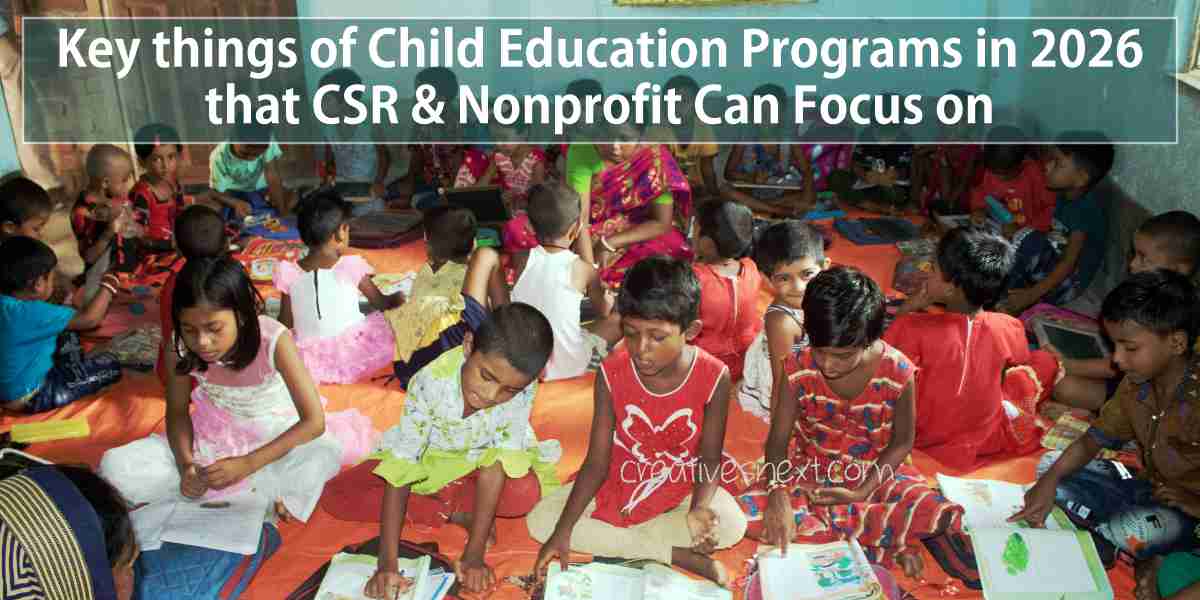
5 Key things of Child Education programs in 2026 that CSR & Nonprofit Must focus on
Published on 10 November 2026
Table of Contents
Introduction
It’s extremely important to take care of different components & the key things of child education while creating the layout of program under CSR (Corporate Social Responsibility) initiatives and nonprofit organizations.
For child education programs in 2026, CSR initiatives should move beyond traditional literacy and numeracy to focus on building holistic, future-ready individuals.
Because, only a well developed child with standard or above the standard cognitive ability will be able to take up the challenge of learning and competing in his/ her intermediate years.
It’s a no brainier that the CSR and Nonprofit organizations must bring their full resources to design, develop and implement the key things of child education program that aims at producing a better human resource.
The landscape of childhood is being radically reshaped by technological acceleration, climate challenges, and evolving societal needs.
As we look towards 2026 for the key things of child education, the traditional model of education, focused predominantly on literacy and numeracy, is no longer sufficient to prepare children for the complexities of the world they will inherit.
Corporate Social Responsibility (CSR) initiatives in education now stand at a critical juncture, tasked with moving beyond infrastructural support to become architects of future-ready learning ecosystems.
The central question is no longer just about building classrooms, but about building resilient, adaptable, and empathetic human beings.
This demands a strategic pivot towards holistic development, where fostering cognitive, social, and emotional skills is intertwined with academic foundations.
The imperative for CSR is clear: to bridge the gap between current educational outcomes and the future’s demands, ensuring that every child, regardless of background, is equipped not merely to navigate the future, but to actively shape it with confidence, creativity, and a sense of responsibility.
Here are the key things for child education programs in 2026 that CSR can focus on, categorized for clarity.
1. Foundational & Future-Proofed Learning in the Key things of Child Education
This is the core academic layer, but re imagined for the modern world.
- Strengthening Foundational Literacy and Numeracy (FLN): This remains the non-negotiable bedrock. CSR can fund programs that use evidence-based pedagogies, teacher training, and personalized learning tools to ensure every child can read with understanding and do basic math by Grade 3.
- STEM/STEAM Integration: Focus on applied Science, Technology, Engineering, Arts, and Math.
- Coding & Computational Thinking: Not just to create programmers, but to develop problem-solving skills. Initiatives could include after-school coding clubs, hackathons, and providing low-cost robotics kits.
- AI & Digital Literacy: Educate children on what AI is, how to use it responsibly as a tool for learning (e.g., for research, editing, brainstorming), and its ethical implications. This is crucial for 2026 and beyond.
- Data and Financial Literacy: Basic skills for the modern world. Teach children how to interpret graphs and data (vital for navigating information) and the fundamentals of saving, budgeting, and digital payments.

2. Socio-Emotional & Holistic Well-Being development focusing on the Key things of Child Education
A child’s ability to learn is deeply connected to their mental and emotional state. The CSR initiatives & Nonprofit organization must focus on while designing the components and key things of child education.
- Mental Health and Resilience Programs: CSR can fund school counselors, train teachers in identifying mental health issues, and integrate mindfulness, yoga, and growth mindset workshops into the curriculum.
- Social-Emotional Learning (SEL): Explicitly teach skills like empathy, collaboration, conflict resolution, and self-awareness. This is critical for building inclusive classrooms and future workplaces.
- Focus on Safety and Inclusion: Ensure programs create safe, bully-free environments that are inclusive of all genders, children with disabilities, and those from marginalized communities.
3. Skills for the Future (The 4 C’s) – Design the Components & Key things of child education accordingly
These are the competencies that automation cannot replace.
- Critical Thinking: Move beyond rote learning. Fund programs that teach children to question, analyze information (especially online), distinguish between fact and opinion, and make reasoned judgments.
- Creativity and Innovation: Support project-based learning, maker-spaces, and arts education that encourage experimentation and “failing forward.”
- Communication: Focus on both verbal and written communication, as well as presentation and storytelling skills in various formats (digital, video).
- Collaboration: Emphasize team-based projects where children learn to work with diverse peers, delegate tasks, and achieve common goals.
4. Leveraging Technology for Equity
Use technology not as a gimmick, but as a tool to bridge gaps.
- Bridging the Digital Divide: This is paramount. CSR can focus on providing internet connectivity, digital devices, and power solutions (like solar-powered computer labs) to underserved schools.
- Personalized Adaptive Learning Software: Fund or develop software that adapts to each child’s learning level, allowing them to learn at their own pace and filling specific learning gaps.
- Teacher Enablement: Use technology for Teacher Professional Development (TPD) through online courses, virtual workshops, and platforms for teachers to share best practices.
5. Sustainability and Global Citizenship
Instill a sense of responsibility for the planet and society.
- Environmental Education (Green Skills): Integrate climate change education, conservation projects, and practical skills like waste management and gardening into the school experience.
- Civic Engagement: Encourage children to understand their community’s issues and participate in small, local problem-solving projects.
- Global and Cultural Awareness: Use technology for virtual student exchanges and collaborative projects with schools in other states or countries to foster a broader worldview.

Actionable CSR Focus Areas for the Key things of Child Education in 2026
Based on the above, here is where a CSR department can direct its resources for maximum impact:
- “Future-Skills” Labs in Government Schools: Establish and maintain tech-enabled labs that offer a blend of STEM (robotics, 3D printing), SEL activities, and creative arts. The focus is on the application of skills.
- Teacher Upskilling Programs: Invest in continuous, high-quality training for teachers on FLN pedagogies, integrating technology, and SEL practices. A empowered teacher is the multiplier.
- Mental Health First Aid in Schools: Train a core group of teachers and staff in every partner school to be “Mental Health First Aiders,” creating a first line of support for students.
- AI-Enabled Personalized Learning Platforms: Partner with EdTech nonprofits to deploy and study the impact of adaptive learning software that helps children master foundational concepts.
- The “Green School” Initiative: A holistic program that includes: a) installing solar panels and water harvesting, b) creating a curriculum around sustainability, and c) student-led eco-clubs to maintain the project.
- Parental Engagement and Digital Literacy: Conduct workshops for parents, especially in low-income communities, to help them support their child’s education, understand online safety, and navigate the digital world.
By focusing on these areas, CSR programs in 2026 can move from being charitable donors to becoming strategic partners in building a generation that is not just educated, but is resilient, empathetic, and equipped to thrive in a complex future.
Conclusion
The role of CSR and Nonprofit organizations in child education for 2026 and beyond must be visionary, as well as foundational. Both in charting the outline for the key things of child education programs and the implementation thereafter, the frame play a pivotal role in making it a grand success.
By strategically focusing on future-proof skills, holistic well-being, and equitable access to technology, corporations can transcend the role of mere benefactors to become vital catalysts for systemic change.
This investment in the child education program is not a peripheral charitable activity but a core commitment to cultivating the next generation of innovators, critical thinkers, and compassionate citizens.
The ultimate return on this investment on the components of kids education programs will be measured not in short-term metrics, but in a more resilient, adaptable, and inclusive society.
Therefore, the call to action for corporate leaders and the nonprofit organization for developing promising child education programs invites their responsibility, partnering with educators and communities to co-create learning environments where every child can discover their potential and thrive in an uncertain world.
The future of our collective progress depends on the seeds of knowledge, skill, and character we choose to plant today the child education programs that reaches every nook and corner of the society..
This a human crafted content, assisted by AI.